Search Describes Solutions -- But What About Problems?
In a previous post I said that Search User Interfaces (UI) have two jobs -- helping people find things and educating them about the catalog's structure. (I'll use "catalog" here under the assumption that I'm describing an e-commerce search system, but much of this post is relevant for other search domains.) The search results, facets, and other elements describe the catalog: the solutions and products available.
But there's a third job that's often not addressed and not always well defined: helping users understand their problem, before they're ready to evaluate solutions. Standard search UI patterns assume the user is already in the right mental state to evaluate what's on offer. The design challenge that I want to discuss, then, is to figure out how best to support problem education in search interfaces.
In 1966, Eugene Schwartz published a now-canonical book about advertising. In it, he describes how buyers pass through a set of stages: unaware → problem-aware → solution-aware → product-aware → most-aware. This insight has driven generations of marketers' thoughts about how to meet potential customers where they are, providing the right information at the right time. (The stage names are clear, except for "most-aware", which refers to consumers making a final evaluation before a purchase.)
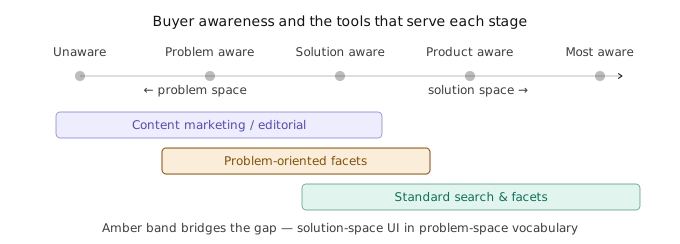
Schwartz's spectrum of awareness for marketing and advertising, with indications of where content marketing, standard search UI, and problem-focused search design address each stage.
Search systems and UI focus on the right half of this sequence. Shoe-store customers probably already know roughly what they want and what styles they prefer, but may still need to learn the site's product lines as they browse.
The left half of this sequence is traditionally delegated to various sorts of advertising and content marketing. Advertisement: "does your back hurt? maybe it's your shoes! http://shoes.com" helps consumers become aware of problems and potential solutions. Content marketing: a TikTok video about cushioning, arch support, and back pain lets consumers find language for their problem, moving them closer to evaluating products.
In my experience, there is a single user awareness journey, but the handoff between marketing and search system design is often not well considered or designed. For low-stakes, simple purchases, users often arrive solution-aware, or even product-aware, and the gap is small. For higher-stakes, complex purchases (think a mattress, a car, injury-specific running shoes, B2B software), users may come to a website only problem-aware, or even unaware or with an incomplete or incorrect notion of their problem. They may need substantial orientation before they can evaluate alternatives.
Jumping to solutions before users fully understand their problem can hurt the business. Customers may buy the wrong thing, become dissatisfied, return the product, and lose trust in the brand.
How can search systems and search UI design help? There are a few ways.
A substantial literature covers how searchers' needs evolve during discovery (Bates, 1989 and Marchionini, 2006 are good starting points). A researcher using a search interface on a database may shift from more exploratory to more targetted search intent as they learn.
Outside of academia, the e-commerce research group Baymard Institute has a name for problem-related (as opposed to solution- or product-related) queries -- "symptom queries." When users search for "dry cough" or "stained rug," they're often disappointed by the search results. Modern semantic search can help somewhat, allowing products with descriptions like "removes stains from fabrics" to be retrieved, but results can still fall short.
Traditionally, product taxonomies use the manufacturer's vocabulary: material, brand, size, color. Not the questions an only problem-aware shopper is asking. One approach is to restructure the taxonomy, revealed through search filters and navigation, around problems to solve rather than properties of products. Problem-oriented facets might be "stays warm when wet" instead of "material: merino"; "good for sensitive skin" instead of "fragrance-free". Or occasion-based facets like "great gifts for teens." Just as facets help the user understand the structure of the solution and product space, they can also help the user understand more about the problem space, letting users name their problem as part of the search.
| Awareness stage | Relevant search UI patterns |
|---|---|
| Problem-aware — finding language for a need | Problem-oriented facets; guided search widgets; embedded marketing content |
| Solution-aware — knows the need, exploring options | Standard and problem-oriented facets |
| Product-aware — comparing specific items | Detailed property facets; comparison tools; reviews |
Two other effective approaches I've seen: guided search widgets that ask users directly where they are in the awareness journey, and embedded marketing content within search results. A widget with query-relevant marketing content, shown within or next to search results, lets users move left, toward problem and solution exploration, rather than forcing them right, toward checkout.
These approaches gain from being grounded in clear conceptual frameworks. Thinking about search's job in frameworks like Schwartz's, or the Christensen & Ulwick Jobs-to-be-Done approach, or even the information-science literature, can help ensure a strong handoff between marketing and on-site search.
Actually implementing problem-oriented design raises practical questions, even if the framework is clear.
Assigning problem-oriented facets at scale can be challenging. First, understand how customers think about and describe their problems -- insights that come from user and market research work. Then, you need to find a way to assign problem-based tags to every item. This used to require expensive human curation, but ML/AI-based labeling has drastically cut the cost. Any e-commerce site with a meaningful catalog and a good understanding of their customers' mental models should at least evaluate problem-oriented facet labeling. The cost could be just pennies per SKU, and the benefits could be substantial.
Thinking about user journeys can also help teams select appropriate search metrics -- if users need to spend time gaining problem and solution awareness, then minimizing metrics such as "time to checkout" or "number of queries before checkout" may actually be counterproductive. Instead, keep the focus on long-term success metrics, and treat intermediate actions such as engagement with marketing and educational material as wins, not distractions.
Finally, it's worth noting that query text itself is an underused signal for a user's stage in the awareness journey. A user who types "best mattress for back pain" is thinking about problems and solutions, while one who types "Tempur-Pedic king" is thinking about products. This information can directionally drive personalized UI design. For problem-vocabulary users, surface more editorial content and orientation information; for product-vocabulary users, surface filters and product comparison tools.
Not enough organizations do this, or do it well. It falls in the gap between marketing and search/product teams, and often nobody owns it. Search teams are usually too focused on the words people are typing, and marketing teams are often just happy to get users onto the website at all. But there's real payoff for getting it right. Users who are supported through each step of the user awareness journey are much more likely to be happy with their purchase, which is what everybody wants.
Notes
- My thinking about this topic was inspired in part by a Venkatesh Rao blog post that goes much further in esoteric directions. Fun over-thought read. Search, Discovery, Pills, and Portals.
- This article was co-authored by AI systems. The initial ideas and direction were mine; the AI did extensive and very useful research as we discussed, I wrote the first draft by hand, and AI made additional suggestions. The diagram in particular should be credited to the AI, after much back-and-forth on the framework.
- Are you looking for support with search and discovery on your company's website? Does this post make you think I could help your company make great design or technology decisions? I'm a freelance consultant with extensive experience -- please reach out!